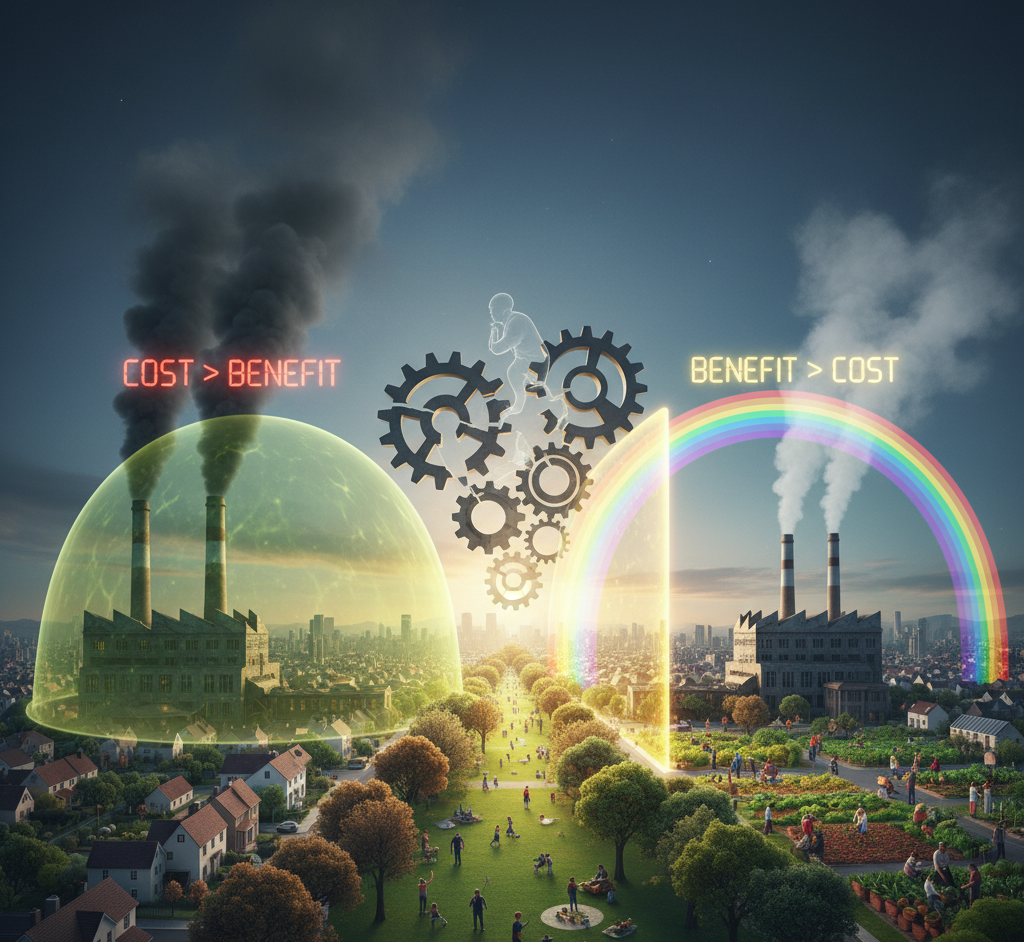
Markets are strong tools for efficient allocation of resources through the power of demand and supply. In the state of perfect competition, full information, and lack of transaction costs, markets can get as close to what economists call Pareto efficiency as possible—a position where no one can be made better off except at the expense of another. But actual markets do not approach these idealized states. Other imperfections and distortions tend to result in inefficiencies and inferior results, in aggregate termed market failures. One of the most important causes of market failure are externalities, which exist when the activities of agents or firms impose costs or bestow benefits on others not captured by market prices. Externalities therefore capture a disparity between social and private costs or benefits, inducing inefficiency and causing market outcomes that do not maximize welfare. An understanding of the nature of externalities, their implications for market performance, and the policy options available to correct them is thus central to economic theory as well as public policy.
Concept and Types of Externalities
An externality is referred to as a spillover impact of an economic action that impacts third parties not directly engaged in the transaction. The impacts may either be positive or negative depending on whether they produce external benefits or external costs. A negative externality arises where an action creates a cost on others, say pollution released by factories, congestion in roads, or second-hand smoke. A negative externality, on the other hand, occurs when others are helped without paying for it, i.e., without compensation, for example, the gains from education, vaccinations, or innovation. In either case, the issue is that market actors—producers and consumers—make choices on the basis of private costs and benefits instead of social costs and benefits. The disparity between private and social results results in overproduction where there are negative externalities and underproduction where there are positive externalities.
For instance, a factory that manufactures steel and releases pollution into the atmosphere. The private production cost of such a factory comprises labor, raw materials, and energy but not the costs to their health and the environment suffered by residents in the surrounding areas. Accordingly, the market price of steel does not capture its real social cost and results in over-production and pollution. The opposite happens in the education sector, where people might invest in education on the basis of individual benefits like higher incomes but ignore the general social benefits like higher productivity, civic mindedness, and lower crime rates. As a result, education is under-consumed compared to the socially optimal one. These easy illustrations show how externalities interfere with markets’ efficient operation and cause welfare loss to be referred to as deadweight loss.
Theoretical Framework: Private and Social Costs and Benefits
In studying externalities more officially, economists make a distinction between marginal private cost (MPC), marginal private benefit (MPB), marginal social cost (MSC), and marginal social benefit (MSB). Equilibrium in a competitive market without externality is where MPC and MPB are equal, and such equilibrium is efficient for society since private and social incentives coincide. But with the existence of externalities, social costs or benefits no longer coincide with private costs or benefits. For negative externalities, MSC is greater than MPC since third parties incur part of the cost. For positive externalities, MSB is greater than MPB since society benefits more from the activity than the individual. Graphically, this results in overproduction when there is a negative externality and underproduction in the presence of a positive externality, both causing losses of welfare.
The traditional diagram of a negative production externality illustrates two supply curves-one for the private cost (MPC) and the other for the social cost (MSC). The market equilibrium is at the intersection of MPC and demand, but the socially optimal equilibrium is at the intersection of MSC and demand. The space between the two points is the deadweight loss, which shows the social inefficiency that results from the externality. For positive externalities, there exists a corresponding diagram, where the MSB curve is higher than the MPB curve, indicating under-consumption compared to the socially optimal amount.
Pigouvian Solution and Corrective Policies
Theoretical underpinnings for dealing with externalities were originally formulated by economist Arthur Cecil Pigou during the early 20th century. Pigou believed that governments need to get involved in markets so that they can correct externalities by matching private and social incentives with Pigouvian taxes and subsidies. For those activities causing adverse externalities, Pigou suggested a tax equivalent to the marginal external cost (MEC) at the socially optimal output level. This Pigouvian tax raises producers’ costs, hence the output is cut to the socially optimal level. The tax makes the price of the good a true representation of its social cost, internalizing the externality. The carbon taxes on greenhouse gas emissions, congestion charges on urban traffic, and excise taxes on alcohol or cigarettes are some examples of Pigouvian taxes.
For positive externalities associated with activities, Pigou suggested subsidies of amounts equal to the marginal external benefit (MEB). These Pigouvian subsidies provide incentives for more production or use of socially beneficial goods like education, health, and research and development (R&D). Subsidizing reduces the private cost or enhances the private benefit, making private incentives and social welfare align. Most government policies, including grants for higher education, tax credits for renewable energy usage, or vaccination program subsidies, are based on Pigouvian concepts.
Although Pigouvian subsidies and taxation offer a conceptually attractive solution, their actual implementation is problematic. The precise size of external costs or benefits can frequently be difficult to ascertain because of measurement issues, uncertainty, and the difficulty of comprehending interactions between sectors and over time. Administrative and political pressures, as well as lobbying, can also skew the design and performance of such policies.
The Coase Theorem and Private Negotiation
Another school of thought on externalities was presented by Ronald Coase in his landmark 1960 work, The Problem of Social Cost. Coase contradicted Pigou’s use of government intervention on the grounds that, in some cases, private negotiation between parties affected by externalities could result in efficient outcomes without state intervention. The Coase Theorem says that parties can negotiate to internalize the externality and make the socially optimal allocation of resources if property rights are defined clearly and if transaction costs approach zero. The initial distribution of rights does not matter.
For instance, if a factory contaminates a river that harms local fishermen, efficiency is possible whether the factory is legally allowed to pollute or the fishermen are legally entitled to clean water. In either case, fishermen would pay for less pollution or the factory would pay the fishermen for losses. In both cases, as long as bargaining is possible and costless, the outcome will maximize joint welfare. However, in practice, transaction costs—such as information asymmetries, bargaining difficulties, and coordination problems—are rarely negligible, particularly in cases involving large numbers of affected parties, as with air pollution or climate change. Therefore, although Coase’s theorem is important in terms of an understanding of the function of property rights and negotiation, it is narrow in its scope and tends to complement, rather than supplant, government intervention.
Market-Based Instruments and Environmental Policy
Contemporary economic policy tends to conflate Pigouvian and Coasean observations in market-based instruments that utilize price signals in order to combat externalities. These tools include subsidies, taxes, tradable permits, and deposit-refund systems, all for the purpose of internalizing benefits or costs of externalities while ensuring flexibility and efficiency. One of the most notable applications is carbon pricing for dealing with the external costs of greenhouse gases. There are two types of carbon pricing: a carbon tax, which simply imposes a fee per ton of emissions, and a cap-and-trade system, which imposes a total limit on emissions and permits firms to buy and sell allowances. Both systems create economic incentives for consumers and firms to cut emissions where it is most cost-effective to do so, meeting environmental objectives at least cost.
The effectiveness of the European Union Emissions Trading System (EU ETS), for instance, shows how tradable permits effectively lower emissions while spurring innovation in cleaner technologies. In the same vein, congestion charges in London and Singapore reduce traffic congestion and air pollution by using a pricing mechanism, reflecting the ability of market-based instruments to effectively control externalities in urban areas. Conversely, subsidies for renewable energy and feed-in tariffs are designed to counteract positive externalities through fostering investment in clean energy, minimizing fossil fuel reliance, and advancing technology.
Although more effective than direct regulation in many cases, market-based instruments need sound design and robust institutions. Their weaknesses include permit allocation, price volatility, and enforcement challenges that can impair their performance. Distributional effects also need to be taken into account since taxes or increased energy prices can be regressive and hurt poor households disproportionately. Policymakers thus tend to use market-based instruments in combination with supporting measures like social transfers, subsidies targeted on poor households, or regulatory standards.
Public Goods and Externalities
Externalities have a close connection with the idea of public goods, which are non-rival and non-excludable. Since public goods cannot exclude people from consuming them, and one’s use doesn’t deplete another’s, markets cannot supply them efficiently. National defense, streetlights, and clean air are a few of them. Public goods naturally create positive externalities because their benefits spill over to those who do not pay for them, resulting in the free-rider problem. Without the intervention of government, these type of goods will be under-supplied or not supplied at all, and this is a serious market failure. Government provision or funding using taxes guarantees that society can benefit from the availability of goods that markets would otherwise under-supply.
Behavioral and Social Dimensions of Externalities
Classic economic theories rely on the assumption of rational choice, yet behavioral economics reveals people tending to behave irrationally under the influence of biases, heuristics, and incomplete information. The behavioral determinants tend to increase or dampen externalities. For instance, behavioral externalities occur when people’s behavior affects others’ conduct by means of social norms or social expectations. Recycling schemes, for example, can generate beneficial social spillovers by inducing “green” behavior, whereas financial-market herd behavior can generate detrimental externalities like bubbles and crashes. Policymakers increasingly turn to nudge policies—gentle, low-key interventions that change behavior without limiting choice—to deal with such externalities. Some examples are default sign-up for green-energy schemes, graphical health warnings on cigarette packs, or opt-out organ donation schemes. By harnessing insights from psychology, behavioral policies complement traditional economic instruments in promoting socially beneficial outcomes.
Global Externalities and Collective Action Problems
Some externalities, particularly environmental ones, transcend national borders and require international cooperation. Climate change is the most prominent example of a global negative externality, as greenhouse gas emissions from one country affect the entire planet. The global scope of the issue generates collective action problems and free riding incentives on others’ work. Arrangements like the Paris Agreement are efforts to coordinate global action by establishing emission goals and encouraging accountability. So are problems such as biodiversity loss, marine pollution, and forest destruction, which emphasize the importance of global governance arrangements to govern common environmental resources, commonly described as global commons. The problem is not merely to develop good policies but also to make them fair, since the benefits and costs of action are disproportionally distributed among countries and generations.
Distributional and Ethical Concerns
In addition to efficiency, externalities also raise significant issues of equity and fairness. Negative externalities tend to burden already-marginalized groups—a situation referred to as environmental injustice. Poorer groups, for instance, might find themselves situated near polluting factories or have reduced access to medical care, incurring greater pollution costs without reaping the economic gains. Likewise, the burden of today’s environmental degradation will be assessed by future generations, creating intergenerational equity issues. Externalities must thus be addressed not just economically but also ethically in terms of who carries the costs and who captures the benefits. Policies like progressive carbon taxes, just transition funds, and community compensation programs seek to address these issues by ensuring the distribution of the adjustment burden in an equitable manner.
Government Intervention: Strengths and Weaknesses
Government intervention is a key instrument in addressing externalities and preventing market failures, though it has its drawbacks. Policies are susceptible to government failure through information asymmetry, administrative slowness, corruption, or political capture. For example, renewable energy subsidies can induce clean technology but burdens and wastage or rent-seeking may result from ill-designed subsidies. Likewise, overregulation can choke innovation and impose unnecessary burdens on business. Optimal policy design must thus seek to balance intervention with market choice, maintain transparency, and regularly review outcomes. Institutional capacity, public trust, and rule of law are the prerequisites for the success of measures correcting externality.
Case Studies and Real-World Examples
Several case studies demonstrate how externalities lead to market failure and how good policy can solve them. The London Congestion Charge, which was implemented in 2003, decreased traffic congestion by more than 30% while raising money for public transport. The Montreal Protocol against ozone-depleting substances is another such success story that shows how international cooperation can dismantle negative externalities. Conversely, the long-term underpricing of fossil fuels and the lagging introduction of carbon taxes across most countries serve to underscore the political challenges of corrective policies even in the face of evident economic logic. On the side of positive externalities, government subsidization of COVID-19 vaccine production illustrates the manner in which public investment can speed up innovation with enormous social gain that would perhaps not be generated by private companies.
Conclusion
Externalities are at the center of market failure, highlighting the shortcomings of unregulated markets to deliver socially optimal results. Whether in terms of pollution, innovation, education, or public health, the wedge between private and social interest means collective action and intervention by the state. Economic theory delivers a powerful toolkit to tackle externalities—from Pigouvian taxes and subsidies to Coasean bargaining and market-based policies like carbon trading. However, successful implementation also needs not just technical accuracy but also political will, institutional soundness, and social sensitivity. In the 21st century, issues such as climate change, inequality, and technological disruption reaffirm the ongoing importance of recognizing externalities both as economic and moral factors. By coordinating private incentives with social objectives, societies can get closer to markets that efficiently allocate resources and also advance equity, sustainability, and long-term prosperity.